The magnetic-field–temperature landscape of UTe2 is where the compound earns its reputation. Ambient-pressure superconductivity is already extreme; above ~30 T the system reinvents itself. This page maps phases papers have delineated, and flags where names (SC1, SC2, SCFP, “halo”) are phenomenology rather than settled microscopic order.
Ambient-pressure superconductivity
At zero field, UTe2 enters a superconducting state at Tc≈1.6 K in early CVT crystals and up to ≈2.1 K in molten-salt crystals[1][9]. The upper critical field Hc2 is strongly anisotropic. Along the magnetic hard b axis, Hc2 far exceeds the conventional Pauli paramagnetic limit HP≈1.86 Tc (~3 T for Tc=1.6 K): discovery-era transport already placed Hc2∥b above 20 T with a conservative extrapolation near 40 T[1]. That Pauli-limit violation is a central experimental pillar for odd-parity / spin-triplet scenarios, though orbital limiting, strong coupling, and spin-orbit locking also reshape Hc2 curves in heavy-fermion systems[9].
Magnetization scaling in the normal state was fit to Belitz–Kirkpatrick–Vojta ferromagnetic quantum-critical exponents in the discovery Science paper, placing UTe2 as a paramagnetic end-member of the uranium ferromagnetic-superconductor series (UGe2, URhGe, UCoGe) rather than an ordered ferromagnet[1].
Metamagnetism near 34–35 T
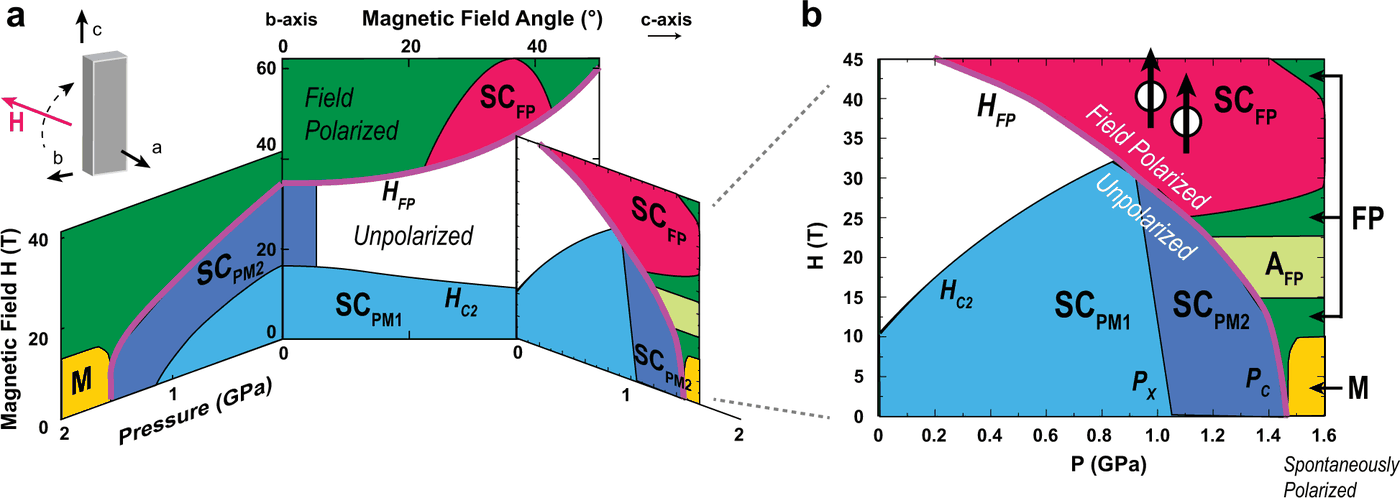
For field along b, a metamagnetic crossover occurs near 34–35 T. Superconductivity is suppressed approaching that scale and then reappears or is strongly reinforced on the high-field side—the field-reentrant / field-boosted regime[2][7][9]. A 2024 Nature Communications study argues that field-induced compensation of magnetic exchange is a plausible microscopic origin of reentrance[7]; that is a proposed mechanism, not a closed case.
Field-boosted and reentrant superconductivity
Ran et al. (Nature Physics 2019) mapped extreme magnetic field-boosted superconductivity, showing enhancement and reentrance in high fields along hard axes[2]. Subsequent work resolved multiple field-induced superconducting pockets along hard axes[8]. Under pressure, the high-field-boosted regime expands[4], tying ambient high-field physics to the pressurized diagram.
High-field superconducting halo (SCFP)
Lewin et al. (Science 2025) mapped a superconducting phase that wraps around the b axis in field-angle space—a halo—and survives above 73 T in pulsed fields[5]. The authors discuss a multicomponent nonunitary spin-triplet order parameter with finite Cooper-pair angular momentum; that is interpretation of phase-boundary geometry, not independent spectroscopic proof of topology[5].
Related “orphan” high-field superconductivity appears even in crystals that are not superconducting at ambient pressure[6], emphasizing that the high-field condensate is not a trivial continuation of the zero-field state.
Pressure
Hydrostatic pressure produces multiple superconducting phases and can induce magnetism at higher pressures. Braithwaite et al. reported multiple superconducting phases in this nearly ferromagnetic system in 2019[3]. Reviews summarize a rich P–T–H diagram with distinct ambient and pressure-induced order parameters[9]. Newer ultrasound and point-contact claims (see feed) should be read in the primary sources.
Naming caution
Literature labels (SC1/SC2/SC3, SCFP, “Weyl”, “PDW”) are not standardized across groups. On this site a name means “the phase boundary reported in the cited experiment,” not a unique microscopic Hamiltonian.
Field-direction cheat sheet
H∥a (easy axis): Superconductivity is suppressed at comparatively modest fields (several tesla in discovery-era crystals). This direction is often used to restore the normal state for specific-heat γ measurements.
H∥b (hard axis): The dramatic direction. Large initial Hc2 slope, metamagnetic jump near 34–35 T, field-reentrant superconductivity, and the angular “halo” of SCFP wrapped around b.
H∥c: Intermediate Hc2; the training axis for polar Kerr experiments that coupled to putative B1g-symmetric TRSB bilinears.
Angle-resolved pulsed-field studies are essential near b because a few degrees of tilt changes whether the field trajectory clips the metamagnetic line or threads a superconducting pocket.
Orphan high-field superconductivity
Frank et al. showed high-field superconductivity in uranium ditelluride specimens that are not superconducting at ambient pressure. That result severs a naive narrative in which SCFP is merely the zero-field condensate dragged to high field. Instead, the high-field ordered state can nucleate from a normal, non-SC ambient ground state—consistent with fluctuation-mediated pairing near the metamagnetic instability rather than a simple continuation of ambient SC1.
Open phase-diagram questions
- How many thermodynamically distinct superconducting order parameters exist along H∥b above 20 T?
- Does the halo phase break inversion symmetry (FFLO-like / finite-momentum pairing), as suggested by diode-effect reports in the feed?
- Where exactly do pressure-induced magnetic phases meet the superconducting lobes (tetracriticality claims)?
- Are SC2 (reentrant) and SCFP (halo) the same condensate in different angular sectors, or distinct?
Each question is experimentally expensive. Treat preprint answers as provisional until independent magnet labs reproduce the boundary.
Compressed experimental timeline
2019: ambient SC + extreme Hc2 (Science); field-boosted SC (Nature Physics); multiple phases under pressure (Communications Physics). 2021: pressure expands high-field-boosted regime (npj Quantum Materials). 2023: multiple hard-axis field-induced SC pockets (PRL). 2024: exchange-compensation scenario for reentrance (Nature Communications); orphan high-field SC (Nature Communications). 2025: superconducting halo above 73 T (Science). The pace means review articles age quickly; prefer the primary boundary plots.
Hc2 numbers worth remembering
Discovery Science (H∥b): slope near Tc about 17 T/K; WHH orbital estimate ~20 T, experimentally exceeded past 20 T with ~40 T extrapolation. Pauli limit ~3 T for Tc=1.6 K—violated along all axes, most extremely along b. Nature Physics field-boosted work and later pulsed-field halo maps push surviving superconductivity beyond 70 T. When quoting a single “Hc2=40 T” number, state the axis and whether it is an extrapolation, a resistive midpoint, or a thermodynamic boundary.
Ferromagnetic quantum-critical framing
Discovery-era magnetization for H∥a failed conventional Arrott–Noakes ferromagnetic scaling but collapsed under Belitz–Kirkpatrick–Vojta exponents (β=1, γ=0.5, δ=1.5) over wide H/T ranges after subtracting a Pauli-like background. That scaling underpinned the claim that UTe2 sits at the paramagnetic end of the UGe2–URhGe–UCoGe line. Whether a true ferromagnetic QCP exists, is avoided, or is replaced by other instabilities under pressure remains a separate experimental program; the scaling observation is still the historical reason “nearly ferromagnetic” appears in titles.
Mechanisms proposed for reentrance
Three families of explanation appear in the opened literature: (i) field-enhanced ferromagnetic-fluctuation pairing strength λ(H) along the hard axis (Mineev-type phenomenology used already in the discovery Science paper’s supplements); (ii) field-induced compensation of magnetic exchange near metamagnetism (Helm et al., Nat. Commun. 2024); (iii) distinct high-field condensates including finite-momentum / nonunitary states inferred from halo geometry (Lewin et al., Science 2025). These are not mutually exclusive, but they are not interchangeable. Cite the paper that actually measured the boundary you are discussing.
Claim → evidence table
| Claim | Primary evidence | Status |
|---|---|---|
| Hc2∥b ≫ Pauli limit | Ran et al., Science 365, 684 (2019) | Solid |
| Field-boosted / reentrant SC along hard axes | Ran et al., Nat. Phys. 15, 1250 (2019); Sakai et al., PRL 130, 196002 (2023) | Solid phenomenology |
| Metamagnetism near 34–35 T for H∥b | High-field transport literature including Helm et al., Nat. Commun. 15, 37 (2024) | Solid |
| Superconducting halo >70 T | Lewin et al., Science 389, 512 (2025) | Solid boundary map; microscopic OP interpretive |
| Orphan high-field SC without ambient SC | Frank et al., Nat. Commun. 15, 3378 (2024) | Reported |
| Multiple pressure-induced SC phases | Braithwaite et al., Commun. Phys. 2, 147 (2019) | Solid |
High-field landscape in one paragraph (Lewin review)
Lewin et al. (Rep. Prog. Phys. 86, 114501, 2023) state the consensus map: superconductivity with huge anisotropic Hc2 surviving to ~35 T, terminated by a discontinuous magnetic (metamagnetic) transition whose field depends on direction; a different reentrant superconducting phase appears only on the high-field side of that transition for angles between b and c. Ambient SC, metamagnetism, and high-field SC are therefore three linked but distinct actors. Pressure adds magnetic order above ~1.5 GPa and splits/raises Tc lobes (Braithwaite et al., Commun. Phys. 2, 147, 2019; Aoki review).
What to realistically expect
Expect: Finer angular maps of SCFP/halo; more orphan-SC and diode-effect tests near metamagnetism; pressure–field diagrams that either confirm or refute tetracriticality claims (Kamat et al., arXiv:2603.17905).
Do not expect: A single “final” H–T–P cartoon next year—pulsed-field thermodynamics is scarce, and labels (SC1/SC2/SC3) still drift between groups.
References
- Ran, S., Eckberg, C., Ding, Q.-P., Furukawa, Y., Metz, T., Saha, S. R., Liu, I.-L., Zic, M., Kim, H., Paglione, J., & Butch, N. P. “Nearly ferromagnetic spin-triplet superconductivity.” Science 365, 684–687 (2019). DOI 10.1126/science.aav8645.
- Ran, S., Liu, I.-L., Eo, Y. S., Campbell, D. J., Neves, P. M., Fuhrman, W. T., Saha, S. R., Eckberg, C., Kim, H., Graf, D., et al. “Extreme magnetic field-boosted superconductivity.” Nature Physics 15, 1250–1254 (2019). DOI 10.1038/s41567-019-0670-x.
- Braithwaite, D., Vališka, M., Knebel, G., Lapertot, G., Brison, J.-P., Pourret, A., Zhitomirsky, M., Flouquet, J., Honda, F., & Aoki, D. “Multiple superconducting phases in a nearly ferromagnetic system.” Communications Physics 2, 147 (2019). DOI 10.1038/s42005-019-0248-z.
- Ran, S., Saha, S. R., Liu, I.-L., Graf, D., Paglione, J., & Butch, N. P. “Expansion of the high field-boosted superconductivity in UTe2 under pressure.” npj Quantum Materials 6, 75 (2021). DOI 10.1038/s41535-021-00376-9.
- Lewin, S. K., Czajka, P., Frank, C. E., et al. “High-field superconducting halo in UTe2.” Science 389, 512–515 (2025). DOI 10.1126/science.adn7673. arXiv:2402.18564.
- Frank, C. E., Lewin, S. K., Saucedo Salas, G., et al. “Orphan high field superconductivity in non-superconducting uranium ditelluride.” Nature Communications 15, 3378 (2024). DOI 10.1038/s41467-024-47090-1.
- Helm, T., Kimata, M., Sudo, K., Miyata, A., et al. “Field-induced compensation of magnetic exchange as the possible origin of reentrant superconductivity in UTe2.” Nature Communications 15, 37 (2024). DOI 10.1038/s41467-023-44183-1.
- Sakai, H., Tokiwa, Y., Opletal, P., et al. “Field Induced Multiple Superconducting Phases in UTe2 along Hard Magnetic Axis.” Physical Review Letters 130, 196002 (2023). DOI 10.1103/PhysRevLett.130.196002.
- Aoki, D., Brison, J.-P., Flouquet, J., Ishida, K., Knebel, G., Tokunaga, Y., & Yanase, Y. “Unconventional superconductivity in UTe2.” Journal of Physics: Condensed Matter 34, 243002 (2022). DOI 10.1088/1361-648X/ac5863.