Surface and spectroscopic probes see UTe2 up close. They have produced some of the most striking images in the field—and some of the hardest-to-reconcile claims once bulk crystal quality improved.
STM: chiral step-edge states
Jiao et al. (Nature 2020) reported scanning tunneling spectroscopy of in-gap states at step edges on UTe2 surfaces, interpreted as chiral edge modes of a spin-triplet condensate[1]. The paper is widely cited for topology. Caveats that matter for this site: early crystals, surface termination sensitivity, and reliance on a chiral framework that bulk Kerr/μSR on clean crystals later challenged[7]. The spectra exist; the topological assignment is an interpretation.
Pair density wave
Gu et al. (Nature 2023) used superconducting tips to resolve ~10 μeV gap modulations at three incommensurate wavevectors matching the normal-state charge-density wave, phase-shifted by ≈π, interpreted as a spin-triplet pair density wave (PDW) on the (0−11) surface[2]. PDW order is a concrete, local observation. Whether it is the bulk ambient order parameter or a surface/secondary instability is not settled by STM alone[2].
Microwave surface impedance
Bae et al. measured surface resistance and reactance near 11 GHz and reported an anomalous residual normal-fluid response argued to fit chiral pairing[3].
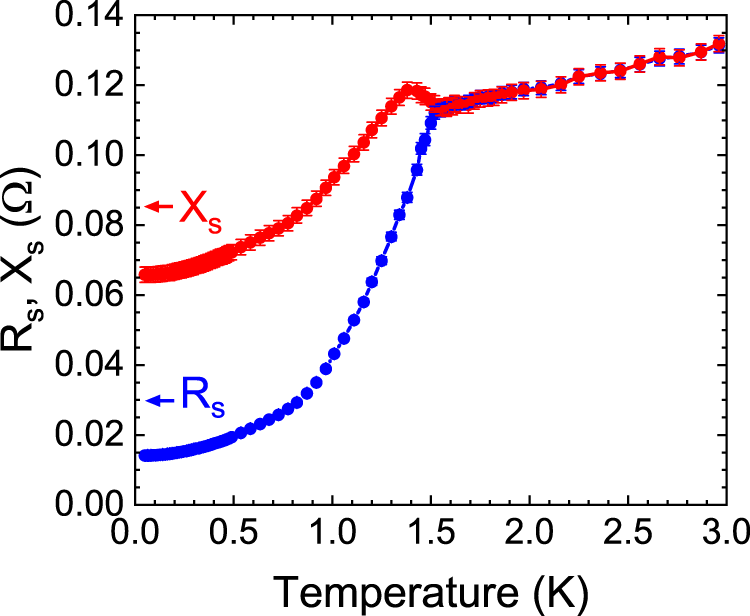
As with other early-crystal results, residual normal fluid can also arise from inhomogeneity. Cross-check against thermal conductivity on MSF crystals before treating residual fluid as intrinsic chirality[5][7].
Penetration-depth anisotropy
Ishihara et al. used anisotropic low-energy excitations / penetration depth to argue for a chiral state[4].
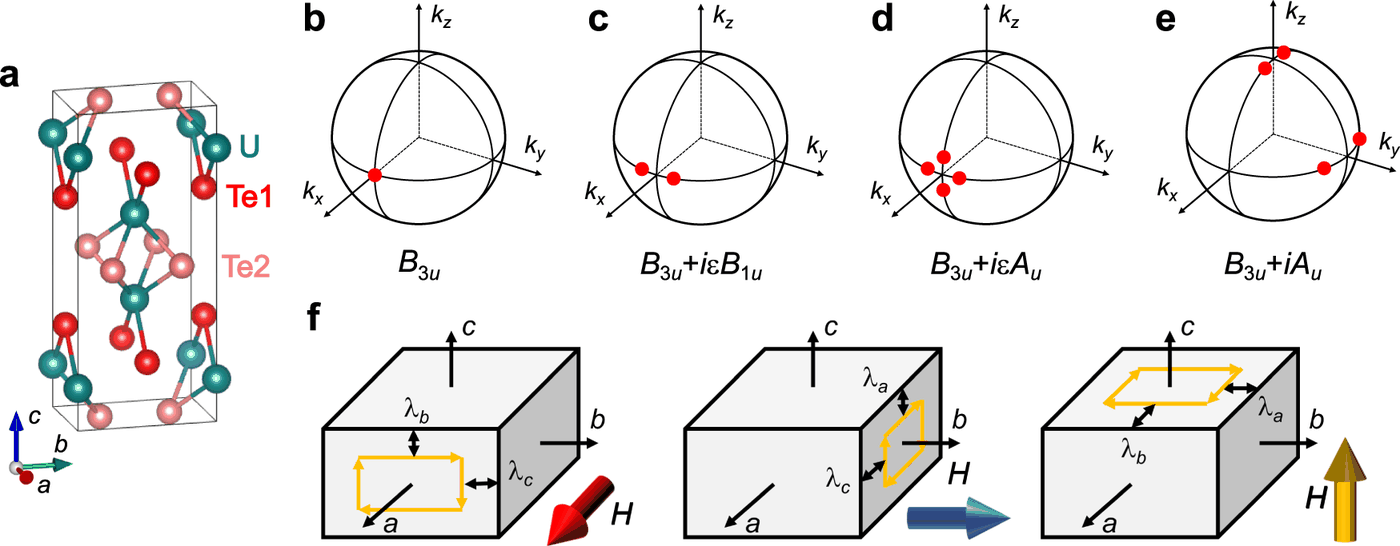
Ajeesh et al. note that related penetration-depth work often involved samples with large residual γ (≥50 mJ mol−1 K−2), i.e. substantial nonsuperconducting volume[7]. Revisit on MSF material is the clean test.
Thermal conductivity: full gap camp
Suetsugu et al. report vanishing residual κ/T on Tc=2.1 K MSF crystals and field dependence matching a full gap, favoring Au[5]. That conflicts with Metz et al.’s earlier point-node conclusion from penetration depth[6] and with other thermal-transport reports favoring nodes (feed). Two credible camps; do not collapse them into one sentence.
Bulk transport dimensionality
Eo et al. find evidence for three-dimensional conductivity components in c-axis transport, cautioning against purely quasi-2D models of the Fermi surface[8]. Band-structure and dHvA work (Aoki et al., elsewhere on this site) should be read together with that constraint.
Energy scales
Superconducting gaps in UTe2 are small—on the order of tens to hundreds of μeV depending on probe and sample—while STM and microwave experiments also contend with surface reconstruction, adsorbates, and vortex cores. PDW modulations at ~10 μeV sit near the edge of spectroscopic resolution; independent replication with different tips and cleaves matters more than a single spectacular map.
Thermal conductivity integrates bulk quasiparticles. When κ/T → 0 as T → 0 on MSF crystals, the residual DOS that early specific-heat work attributed to nonunitary half-gapping is no longer required. That does not erase STM PDW or early microwave residual fluid; it forces a two-tier model: surface/inhomogeneous phenomena versus clean bulk gap structure.
Replication priorities
Highest value experiments: (1) PDW maps on MSF-cleaved surfaces; (2) microwave impedance on the same MSF pieces used for κ(T); (3) quasiparticle interference that can distinguish chiral edge modes from trivial Andreev states; (4) simultaneous specific heat + STM on crystals with documented single transitions. Until those exist, surface–bulk dualism should be the default reading frame.
Jiao et al. step edges — what was measured
The Nature 2020 STM study resolved in-gap conductance at atomic step edges with a particle–hole asymmetric lineshape argued to match chiral edge modes. The crystals were discovery-generation CVT material. No claim in that paper measures bulk TRSB; the chiral label is inferred from the edge-mode phenomenology plus the broader triplet context. After Ajeesh/Azari, the correct citation practice is: “STM reports chiral-consistent edge states on early crystals; bulk TRSB on clean crystals is contested.”
PDW — what was measured
Gu et al. used a superconducting tip to enhance energy resolution and found gap-magnitude modulations at three CDW-related wavevectors with approximately π phase shifts between pair-density and charge-density components—the PDW fingerprint. The surface was (0−11). Whether PDW coexists with a uniform condensate in the bulk, replaces it in a surface reconstruction, or is disorder-stabilized is not answered by topographic spectroscopy alone. Bulk probes sensitive to finite-momentum pairing (e.g. Josephson diode effects near metamagnetism; see feed) are the natural cross-check.
Surface chemistry caveats
UTe2 surfaces oxidize and can host uranium-rich or tellurium-rich terminations. STM and Kerr both care. Polishing for optics (as in Ajeesh et al.) can leave ferromagnetic impurity streaks on MSF crystals (U7Te12 risk). As-cleaved surfaces for STM may not represent the same chemistry as polished ab planes for Kerr. Cross-technique contradictions sometimes encode surface preparation rather than bulk order-parameter war.
Microwave quantities
Bae et al. report surface resistance Rs and reactance Xs near 11.26 GHz. In a two-fluid picture, residual Rs tracks unpaired carriers; an anomalous temperature dependence was argued to fit chiral pairing with Majorana-like contributions. Alternative explanations include trapped flux, inhomogeneity, and disorder-induced residual fluid—especially acute for CVT crystals with large γ*. Repeating the identical cavity measurement on MSF crystals with Suetsugu-like κ(T) would be decisive; that dataset is not in the opened bibliography yet.
Claim → evidence table
| Claim | Primary evidence | Status |
|---|---|---|
| Chiral-consistent step-edge in-gap states | Jiao et al., Nature 579, 523 (2020) | Observation solid; topological assignment interpretive |
| Surface PDW at CDW wavevectors | Gu et al., Nature 618, 921 (2023) | Strong local evidence |
| Anomalous microwave normal fluid from chirality | Bae et al., Nat. Commun. 12, 2644 (2021) | Contested interpretation |
| Anisotropic low-energy excitations ⇒ chiral OP | Ishihara et al., Nat. Commun. 14, 2966 (2023) | Contested on clean-crystal grounds |
| Bulk full gap on MSF crystals | Suetsugu et al., Sci. Adv. 10, eadk3772 (2024) | Strong thermal-transport evidence |
Thermal conductivity: two camps, named
Full-gap camp: Suetsugu et al. (Science Advances 10, eadk3772, 2024) on molten-salt crystals with Tc=2.1 K report residual κ/T consistent with a fully gapped state and field dependence resembling conventional full-gap behavior, favoring Au-like pairing over B3u with a-axis nodes.
Nodal camp: Hayes, Metz, Frank, Saha, Butch, Mishra, Hirschfeld and Paglione (arXiv:2402.19353) argue for robust nodal behavior in thermal conductivity of superconducting UTe2, keeping point nodes in play. Metz et al. (Phys. Rev. B 100, 220504, 2019) earlier inferred point nodes from penetration-depth / microwave analyses on discovery-generation crystals.
A responsible reading does not average these into one gap. It tracks crystal quality (RRR, residual γ*), field orientation, and whether residual normal fluid is extrinsic. Until both camps measure the same MSF pieces with the same thermometry, the gap-structure question stays open.
NMR context from the Aoki review
The 2022 JPCM review collects early Knight-shift and 1/T1 results: roughly temperature-independent or only slightly decreasing Knight shift below Tc along principal axes was a primary microscopic argument for triplet pairing, while the absence of a Hebel–Slichter peak fits non-s-wave gaps generally. Li et al. (PNAS 2025) explicitly note that a small Knight-shift drop along b can also arise in singlet scenarios with strong spin–orbit coupling—one reason Josephson parity tests matter.
Matsumura et al. (Phys. Rev. B 111, 174526, 2025) on ultraclean Tc=2.1 K crystals find spin susceptibility decreases along b and c as well as a, so the d-vector is not locked to a single axis. That is progress on spin structure without resolving nodes.
What to realistically expect
Expect: More surface PDW / QPI maps; more thermal-conductivity papers that state RRR and residual γ* in the abstract; gradual convergence—or continued split—between nodal and full-gap reports as MSF crystals proliferate.
Do not expect: A single STM image to settle bulk topology, or microwave residual fluid alone to prove chirality after clean-crystal Kerr nulls.
Timescale: Independent replications on shared crystal batches are the bottleneck, not theory. That is a multi-year materials-and-probe problem.
References
- Jiao, L., Howard, S., Ran, S., Wang, Z., Rodriguez, J. O., Sigrist, M., Wang, Z., Butch, N. P., & Madhavan, V. “Chiral superconductivity in heavy-fermion metal UTe2.” Nature 579, 523–527 (2020). DOI 10.1038/s41586-020-2122-2.
- Gu, Q., Carroll, J., Wang, S., Ran, S., et al. “Detection of a pair density wave state in UTe2.” Nature 618, 921–927 (2023). DOI 10.1038/s41586-023-05919-7.
- Bae, S., Kim, H., Eo, Y. S., Ran, S., Liu, I.-L., Fuhrman, W. T., Paglione, J., Butch, N. P., & Anlage, S. M. “Anomalous normal fluid response in a chiral superconductor UTe2.” Nature Communications 12, 2644 (2021). DOI 10.1038/s41467-021-22906-6.
- Ishihara, K., Roppongi, M., Kobayashi, M., Mizukami, Y., Sakai, H., Haga, Y., Hashimoto, K., & Shibauchi, T. “Chiral superconductivity in UTe2 probed by anisotropic low-energy excitations.” Nature Communications 14, 2966 (2023). DOI 10.1038/s41467-023-38688-y.
- Suetsugu, S., Shimomura, M., Kamimura, M., et al. “Fully gapped pairing state in spin-triplet superconductor UTe2.” Science Advances 10, eadk3772 (2024). DOI 10.1126/sciadv.adk3772.
- Metz, T., Bae, S., Ran, S., Liu, I.-L., Eo, Y. S., Fuhrman, W. T., Agterberg, D. F., Anlage, S. M., Butch, N. P., & Paglione, J. “Point-node gap structure of the spin-triplet superconductor UTe2.” Physical Review B 100, 220504 (2019). DOI 10.1103/PhysRevB.100.220504.
- Ajeesh, M. O., Bordelon, M., Girod, C., Mishra, S., Ronning, F., Bauer, E. D., Maiorov, B., Thompson, J. D., Rosa, P. F. S., & Thomas, S. M. “Fate of Time-Reversal Symmetry Breaking in UTe2.” Physical Review X 13, 041019 (2023). DOI 10.1103/PhysRevX.13.041019.
- Eo, Y. S., Liu, S., Saha, S. R., Kim, H., Ran, S., et al. “c-axis transport in UTe2: Evidence of three-dimensional conductivity components.” Physical Review B 106, L060505 (2022). DOI 10.1103/PhysRevB.106.L060505.