Whether UTe2 breaks time-reversal symmetry (TRS) in its superconducting state is the single most consequential open question for “chiral” and topological claims. The experimental record is contradictory. This page walks through that record in chronological order and states the present tension without picking a winner the data have not earned.
Hayes et al.: Kerr onset and split Tc
Hayes, Wei, Kapitulnik, Paglione and collaborators reported a polar Kerr effect that onsets near Tc≈1.6 K, is trainable by a small c-axis field (~±25 G), and saturates near ~400 nrad[1]. Zero-field-cooled runs sometimes showed a finite Kerr signal and sometimes did not—interpreted as random chiral-domain formation under a ~10 μm optical beam[1]. The same work reported a shoulder in specific heat ~75–100 mK above the main peak on four crystals, taken as a second thermodynamic transition required for TRSB when all D2h irreps are one-dimensional[1]. Symmetry analysis then limited candidates to B3u+iB2u or B1u+iAu (odd-parity pairs), with Weyl nodes argued to be generic for B2u+iB3u[1].
A follow-up Physical Review B paper examined larger training fields and discussed scaling of Kerr rotation with field in terms of a critical state of ferromagnetic vortices[2]. Those Kerr data were obtained primarily on crystals that show double transitions and relatively large residual specific heat—the same class later flagged as inhomogeneous[3][9].
Ajeesh et al.: no spontaneous Kerr on single-Tc crystals
Ajeesh, Thomas, Rosa and collaborators at Los Alamos measured polar Kerr on four crystals spanning CVT and MSF growth with single specific-heat transitions (Tc=1.6–2.1 K)[3]. Zero-field heat-pulse protocols that repeatedly cycle through Tc found no spontaneous Kerr onset at Tc. The standard deviation of θK above and below Tc did not increase in the way expected from random chiral domains of the size inferred from earlier work[3].
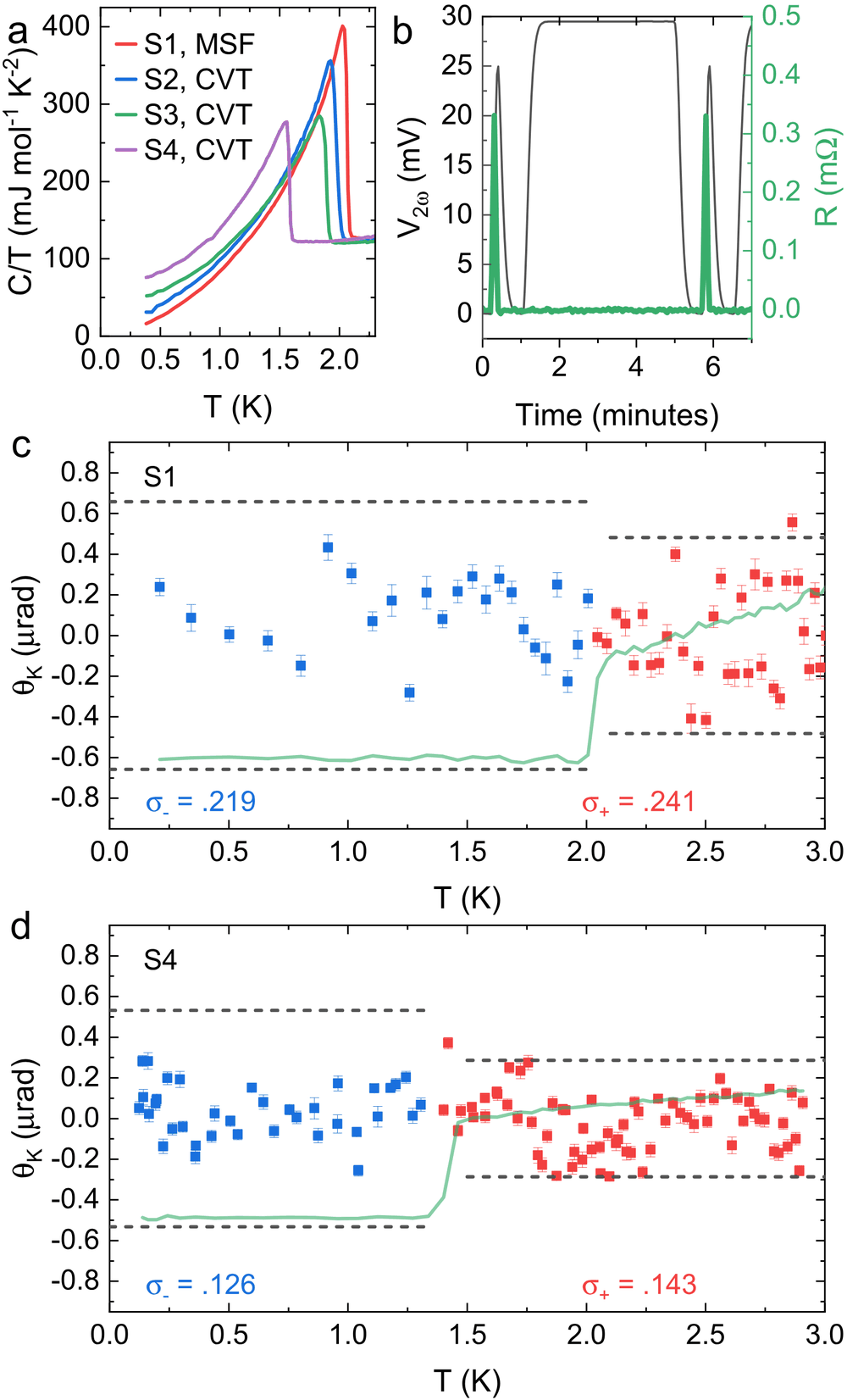
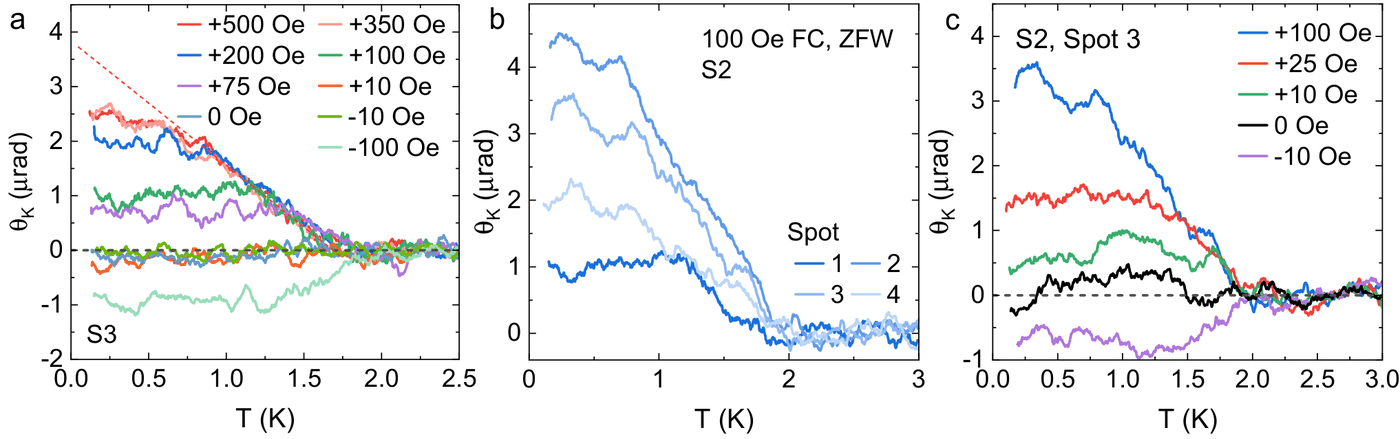
They do observe a field-trainable Kerr signal that vanishes at Tc, but its magnitude varies by more than a factor of four between spots on the same crystal—pointing to inhomogeneous magnetism / vortex pinning rather than a uniform chiral condensate[3]. Ac susceptibility on a parallel set of crystals shows that lower-Tc samples have stronger vortex pinning (peak effect), correlating defect density with the older double-transition phenomenology[3]. Their conclusion: intrinsic TRSB is unlikely; chiral order-parameter scenarios built primarily on Kerr should be reevaluated[3].
Muon spin relaxation
Early μSR on CVT material found dynamic local fields that complicated TRSB searches[5]. Azari et al. (PRL 2023) report zero-field μSR on molten-salt crystals with no spontaneous fields below Tc and without the magnetic-cluster relaxation that plagued dirtier CVT samples—another strike against bulk TRSB in clean UTe2[4].
Other “chiral” evidence (context)
STM step-edge in-gap states[6], microwave normal-fluid response[7], and anisotropic penetration-depth analyses[8] have all been interpreted as supporting chirality. Ajeesh et al. note that several of these arguments relied on assuming TRSB to rule out alternatives, and that samples often had large residual γ[3]. Those experiments remain part of the literature; they are not nullified, but their chiral interpretation is weaker if bulk TRSB is absent.
Status as of late 2026
Claim that still has direct support: some crystals (especially double-transition / high-γ* CVT) show Kerr signals associated with superconductivity[1][2].
Claim that clean single-Tc crystals support: no spontaneous zero-field Kerr; trainable signals look extrinsic; μSR finds no spontaneous fields[3][4].
Fair summary: bulk intrinsic TRSB at ambient pressure is contested and currently disfavored by the cleanest-crystal Kerr/μSR work, while older chiral interpretations remain in textbooks and reviews that predate those null results. High-field and pressure phases can still break additional symmetries without requiring ambient TRSB[3].
Domain arguments, quantified
Hayes/Wei reported run-to-run scatter in zero-field Kerr below Tc consistent with ~6 μm domains under a 10 μm beam if the single-domain amplitude is ~0.4 μrad. Ajeesh et al. inverted that test: with equal beam size, cleaner crystals should host larger domains and therefore larger spontaneous scatter if chirality were intrinsic. They did not observe that increase. That is a direct, quantitative conflict—not a vague “sample dependence” shrug.
Field-trainable Kerr that scales with cooling field up to a saturation set by H* (flux front reaching the sample center) can arise from pinned vortices and local moments without bulk TRSB. Spot-to-spot variation near the sample center is especially hard to reconcile with a uniform ferromagnetic vortex lattice remnant magnetization, which should be relatively flat in the critical-state model.
Double transitions as a red flag
Rosa et al. and Ajeesh et al. place double specific-heat peaks primarily in lower-quality CVT crystals. Hayes et al. used the double peak as positive evidence for two order parameters. Both statements can be experimentally true at once: some crystals show two peaks, and those peaks need not be intrinsic multicomponent order. Stress experiments that would split B3u+iB2u have not delivered the expected splitting on single-transition samples, further weakening the intrinsic-multicomponent ambient story.
What “field training” means experimentally
In the Kapitulnik-style zero-area Sagnac setup (1550 nm), a typical protocol cools through Tc in a small c-axis field, sets H→0 at base temperature, then warms while recording θK. Hayes et al. used ±25 G training and saw antisymmetric Kerr saturation near 400 nrad. Wei et al. explored higher training fields and discussed ferromagnetic vortex critical-state scaling. Ajeesh et al. added an essential control: laser (or heater) pulses that drive the sample normal in zero field between points, randomizing any domain configuration—yet spontaneous Kerr still did not appear on single-Tc crystals. Without that control, remnant magnetization can masquerade as order-parameter TRSB.
Optical penetration at 1550 nm is only ~300 nm (as cited from optical-conductivity work in Ajeesh et al.), so Kerr is a near-surface probe. μSR averages the bulk. Agreement between Ajeesh Kerr nulls and Azari μSR nulls on MSF crystals is therefore stronger than either alone.
Claim → evidence table
| Claim | Primary evidence | Status |
|---|---|---|
| Spontaneous Kerr at Tc on double-transition crystals | Hayes et al., Science 373, 797 (2021); Wei et al., PRB 105, 024521 (2022) | Reported on that crystal class |
| No spontaneous Kerr on single-Tc CVT/MSF crystals | Ajeesh et al., PRX 13, 041019 (2023) | Strong null |
| Field-trainable Kerr is extrinsic / inhomogeneous | Spot-to-spot variation in Ajeesh et al. | Well supported |
| No spontaneous μSR fields on MSF crystals | Azari et al., PRL 131, 226504 (2023) | Strong null |
| STM/microwave “chiral” signatures imply bulk TRSB | Jiao 2020; Bae 2021; Ishihara 2023 | Inference weakened if bulk TRSB absent |
What to realistically expect
Expect: Further Kerr/μSR on MSF crystals; possible surface-only TRSB scenarios that do not imply bulk chirality; continued citation of Hayes et al. as historical positive evidence on double-transition crystals.
Do not expect: Ambient-pressure bulk chiral TRSB to return as consensus without new spontaneous Kerr on single-Tc ultraclean crystals. High-field nonunitary states can still break TRS without resurrecting the ambient Kerr claim.
References
- Hayes, I. M., Wei, D. S., Metz, T., Zhang, J., Eo, Y. S., Ran, S., Saha, S. R., Collini, J., Butch, N. P., Agterberg, D. F., Kapitulnik, A., & Paglione, J. “Multicomponent superconducting order parameter in UTe2.” Science 373, 797–801 (2021). DOI 10.1126/science.abb0272. arXiv:2002.02539.
- Wei, D. S., Saykin, D., Miller, O. Y., Ran, S., Saha, S. R., Agterberg, D. F., Schmalian, J., Butch, N. P., Paglione, J., & Kapitulnik, A. “Interplay between magnetism and superconductivity in UTe2.” Physical Review B 105, 024521 (2022). DOI 10.1103/PhysRevB.105.024521.
- Ajeesh, M. O., Bordelon, M., Girod, C., Mishra, S., Ronning, F., Bauer, E. D., Maiorov, B., Thompson, J. D., Rosa, P. F. S., & Thomas, S. M. “Fate of Time-Reversal Symmetry Breaking in UTe2.” Physical Review X 13, 041019 (2023). DOI 10.1103/PhysRevX.13.041019. arXiv:2305.00589.
- Azari, N., Yakovlev, M., Rye, N., Dunsiger, S. R., et al. “Absence of Spontaneous Magnetic Fields due to Time-Reversal Symmetry Breaking in Bulk Superconducting UTe2.” Physical Review Letters 131, 226504 (2023). DOI 10.1103/PhysRevLett.131.226504. arXiv:2308.09773.
- Sundar, S., Gheidi, S., Akintola, K., Côté, A. M., Dunsiger, S. R., Ran, S., Butch, N. P., Saha, S. R., Paglione, J., & Sonier, J. E. “Coexistence of ferromagnetic fluctuations and superconductivity in the actinide superconductor UTe2.” Physical Review B 100, 140502 (2019). DOI 10.1103/PhysRevB.100.140502.
- Jiao, L., Howard, S., Ran, S., Wang, Z., Rodriguez, J. O., Sigrist, M., Wang, Z., Butch, N. P., & Madhavan, V. “Chiral superconductivity in heavy-fermion metal UTe2.” Nature 579, 523–527 (2020). DOI 10.1038/s41586-020-2122-2.
- Bae, S., Kim, H., Eo, Y. S., Ran, S., Liu, I.-L., Fuhrman, W. T., Paglione, J., Butch, N. P., & Anlage, S. M. “Anomalous normal fluid response in a chiral superconductor UTe2.” Nature Communications 12, 2644 (2021). DOI 10.1038/s41467-021-22906-6.
- Ishihara, K., Roppongi, M., Kobayashi, M., Mizukami, Y., Sakai, H., Haga, Y., Hashimoto, K., & Shibauchi, T. “Chiral superconductivity in UTe2 probed by anisotropic low-energy excitations.” Nature Communications 14, 2966 (2023). DOI 10.1038/s41467-023-38688-y.
- Rosa, P. F. S., Weiland, A., Fender, S. S., Scott, B. L., Ronning, F., Thompson, J. D., Bauer, E. D., & Thomas, S. M. “Single thermodynamic transition at 2 K in superconducting UTe2 single crystals.” Communications Materials 3, 33 (2022). DOI 10.1038/s43246-022-00254-2.