UTe2 is an orthorhombic uranium telluride. Getting the crystal structure and growth chemistry right is not bookkeeping: nearly every contested claim in this field (double transitions, Kerr rotation, residual specific heat, gap nodes) tracks sample quality. This page sticks to what diffraction and growth papers actually measured.
Crystal structure
Single-crystal neutron diffraction shows that UTe2 adopts the body-centered orthorhombic space group Immm (No. 71) and that this structure persists from room temperature down to 2.7 K—just above the superconducting Tc of early crystals—with no structural phase transition into the superconducting regime[1]. Uranium atoms form chains along the crystallographic a axis; tellurium occupies two inequivalent sites. The first coordination sphere of U by Te anions at 2.7 K is documented with anisotropic displacement ellipsoids in the Acta Cryst. B study[1].
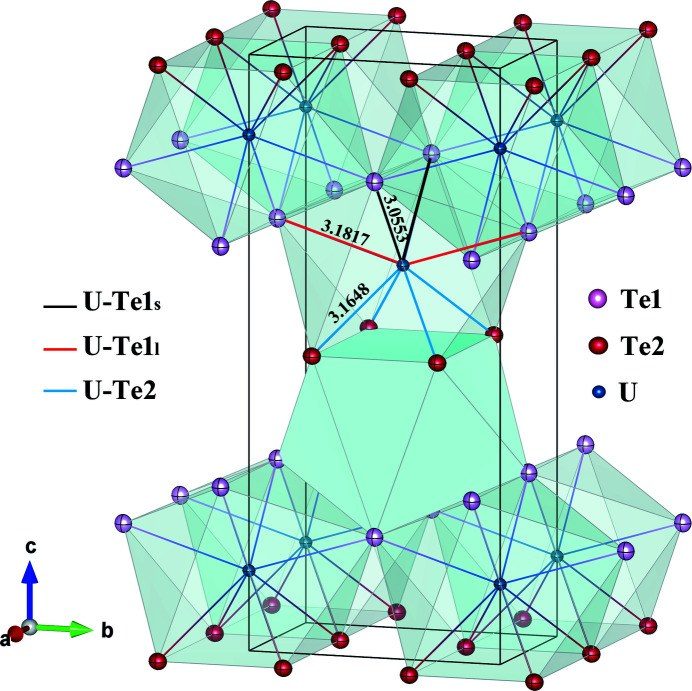
Centrosymmetry of Immm matters for pairing taxonomy: all irreducible representations of the D2h point group are one-dimensional, so a time-reversal-symmetry-breaking superconducting state cannot be a single irreducible representation; it would require a multicomponent combination (see TRS & chirality)[6][8].
Discovery-era chemical vapor transport
The 2019 discovery papers grew millimeter-scale crystals by chemical vapor transport (CVT) with iodine as the transport agent, using U:Te ratios near 2:3 and a hot/cold zone near 1060/1000 °C[2]. Those crystals showed bulk superconductivity at Tc≈1.6 K, residual resistivity ratios (RRR) typically in the teens to ~40, and a large residual Sommerfeld coefficient γ0 in the superconducting state (~55 mJ mol−1 K−2 in the Science report)[2]. An independent Tohoku/CEA Grenoble CVT confirmation found superconductivity near 1.65 K with a large specific-heat jump and heavy-fermion γ[3].
CVT growth is sensitive to temperature and stoichiometry. Lower growth temperatures can raise Tc toward ~2 K, while growth near the edge of the stability window can produce crystals with apparent double transitions in specific heat and large residual γ[5][6]. That double-peak phenomenology was later interpreted by several groups as inhomogeneity rather than intrinsic multicomponent order—see below.
Molten-salt flux (MSF) crystals
Sakai et al. introduced a molten-salt flux growth that uses excess uranium and yields crystals with Tc up to 2.1 K, dramatically higher RRR (hundreds to ~103), and a tiny residual specific heat compared with early CVT material[4]. Those improvements enabled de Haas–van Alphen oscillations and clearer Fermi-surface constraints[7]. MSF crystals are now the benchmark for “ultraclean” UTe2, but they are not magic: ferromagnetic impurity phases (e.g. U7Te12) can appear and must be checked magnetically and optically[6].
What “quality” changes experimentally
Rosa et al. showed that optimally grown crystals with Tc≈2 K exhibit a single thermodynamic transition in specific heat and a reduced residual heat capacity, undercutting the idea that ambient-pressure double transitions are an intrinsic multicomponent signature[5]. Ajeesh et al. tabulated CVT and MSF samples spanning Tc=1.6–2.1 K: as Tc rises, residual γ* falls (from ~61 down to ~6 mJ mol−1 K−2 in their set), and vortex pinning (peak effect in ac susceptibility) weakens—i.e. higher-Tc crystals have fewer pinning centers[6].
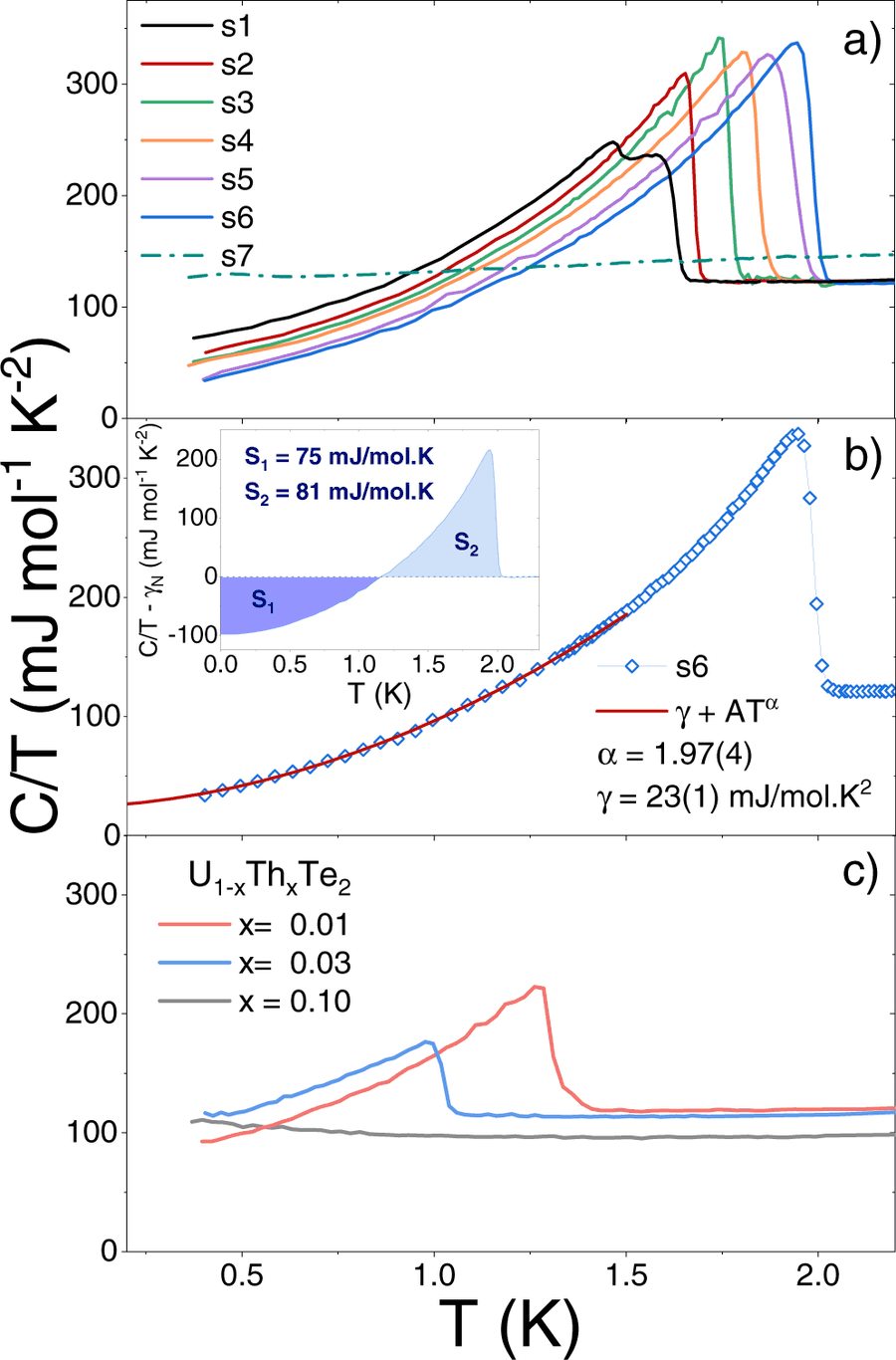
Practical reading rule used on this site: when a dramatic claim (spontaneous Kerr, large residual normal fluid, double Tc) comes from crystals with large γ* or low RRR, treat it as provisional until repeated on MSF-grade material. That rule is empirical, not philosophical—it is what the clean-crystal literature has repeatedly forced[4][5][6][8].
Practical hazards (not physics hype)
Uranium compounds are radioactive and legally controlled. Growing or machining UTe2 is not a hobby project. This site does not provide synthesis recipes beyond what published papers already state for scientific context.
What Immm implies for pairing labels
Because the crystal is centrosymmetric orthorhombic, the relevant point group for the normal state is D2h. Every irreducible representation is one-dimensional. Labeling schemes in the UTe2 literature (Au, B1u, B2u, B3u for odd parity; Ag/Big for even parity) refer to how the gap function transforms under 180° rotations about a, b, and c. A single-irrep odd-parity state is automatically time-reversal symmetric; breaking TRS requires either a magnetic field, ferromagnetism, or a complex combination of two irreps. That group-theory fact is why the double-transition / Kerr story mattered so much, and why the single-transition clean-crystal Kerr null is so consequential for ambient-pressure chirality claims.
Neutron work also constrains structural myths: there is no low-temperature orthorhombic-to-something-else transition hiding under Tc that would suddenly allow a two-dimensional irrep. If future diffraction finds a subtle distortion, that would reopen classification—but the published 2.7 K structure does not provide one.
Uranium vacancies and stoichiometry
Multiple growth papers converge on uranium deficiency as a Tc killer. CVT charges that are Te-rich relative to ideal UTe2 can still transport crystals, but vacancy disorder broadens transitions, inflates residual γ, and correlates with the magnetic clusters seen by μSR on dirty samples. MSF growth with excess U is, in that sense, a chemical fix for a crystallographic problem: fill the U site, raise RRR, collapse residual heat capacity, and only then ask which “exotic” signals survive.
When comparing two papers, matching nominal Tc is not enough. Prefer tables that list residual resistivity, residual γ*, and whether specific heat shows one peak or two. Those three numbers predict, better than the abstract’s adjectives, whether a Kerr, STM, or microwave claim is likely to generalize.
Orientation and twinning
The orthorhombic axes are magnetically inequivalent: a is the easy magnetic axis, b the hard axis that hosts metamagnetism near 35 T, and c the axis used for Kerr training fields in the TRSB studies. Mislabeling a and b on a cleaved rectangular prism is a known practical hazard. Laue x-ray orientation, as used in the discovery methods sections, is mandatory for quantitative Hc2 anisotropy. Twinned or multi-domain crystals can fake “two transitions” in specific heat without any multicomponent order parameter.
CVT protocol as published
Ran et al. sealed elemental U and Te near a 2:3 atomic ratio with ~3 mg cm−3 iodine in evacuated quartz, held in a ~1060/1000 °C gradient for seven days, then furnace-cooled. Orientation used Laue diffraction; powder XRD on crushed crystals checked phase purity. Neutron diffraction on NG-4 at NCNR found no structural or magnetic transition down to 5 K in that study’s methods appendix. RRR values for those discovery batches clustered roughly 18–30. Those numbers define the “early CVT” quality tier against which later MSF crystals should be compared.
Resistivity followed ρ = A T2 at low T with A on the order of 1 μΩ cm K−2, and γ≈120 mJ mol−1 K−2 in the normal state, giving a Kadowaki–Woods ratio typical of heavy-fermion metals. Curie–Weiss fits to high-T magnetization gave ~2.8 μB/U. None of that normal-state phenomenology requires superconductivity; it frames why ferromagnetic-fluctuation pairing scenarios were proposed immediately.
Operational quality metrics
Use this ordered list when ranking crystals across papers:
- Thermodynamic Tc and transition width in C/T.
- Residual γ* from low-T C/T.
- RRR from ρ(300 K)/ρ0 with ρ0 from an AT2+ρ0 fit.
- Single vs double peak in specific heat.
- Presence/absence of ferromagnetic impurity signatures (χ, Kerr maps).
MSF crystals that clear items 1–4 with Tc≈2.1 K and γ*≲10 mJ mol−1 K−2 are the current gold standard for intrinsic ambient-pressure claims.
Claim → evidence table
| Claim | Primary evidence | Status |
|---|---|---|
| Structure is Immm down to ~2.7 K | Hutanu et al., Acta Cryst. B 76, 137–143 (2020) | Solid |
| CVT yields bulk SC near 1.6 K | Ran et al., Science 365, 684 (2019); Aoki et al., JPSJ 88, 043702 (2019) | Solid |
| MSF raises Tc to ~2.1 K and collapses γ* | Sakai et al., Phys. Rev. Mater. 6, 073401 (2022) | Solid |
| Ambient double C/T peaks are intrinsic multicomponent order | Hayes et al. argued yes; Rosa/Ajeesh argue inhomogeneity | Contested — currently disfavored for clean crystals |
| U vacancies suppress Tc | Growth systematics in Sakai/Rosa literature | Strongly supported |
What to realistically expect
Expect: MSF (or equivalent) crystals to remain the standard for “intrinsic” claims; residual γ* and RRR to appear in abstracts more often; occasional ferromagnetic impurity warnings on MSF batches (Ajeesh et al.).
Do not expect: Early CVT double-peak / large-γ* phenomenology to define the ambient order parameter going forward.
References
- Hutanu, V., Deng, H., Ran, S., Fuhrman, W. T., Thoma, H., & Butch, N. P. “Low-temperature crystal structure of the unconventional spin-triplet superconductor UTe2 from single-crystal neutron diffraction.” Acta Crystallographica Section B 76, 137–143 (2020). DOI 10.1107/S2052520619016950.
- Ran, S., Eckberg, C., Ding, Q.-P., Furukawa, Y., Metz, T., Saha, S. R., Liu, I.-L., Zic, M., Kim, H., Paglione, J., & Butch, N. P. “Nearly ferromagnetic spin-triplet superconductivity.” Science 365, 684–687 (2019). DOI 10.1126/science.aav8645. arXiv:1811.11808.
- Aoki, D., Nakamura, A., Honda, F., Li, D., Homma, Y., Shimizu, Y., Sato, Y. J., Knebel, G., Brison, J.-P., Pourret, A., et al. “Unconventional Superconductivity in Heavy Fermion UTe2.” Journal of the Physical Society of Japan 88, 043702 (2019). DOI 10.7566/JPSJ.88.043702. arXiv:1903.02410.
- Sakai, H., Opletal, P., Tokiwa, Y., Yamamoto, E., Tokunaga, Y., Kambe, S., & Haga, Y. “Single crystal growth of superconducting UTe2 by molten salt flux method.” Physical Review Materials 6, 073401 (2022). DOI 10.1103/PhysRevMaterials.6.073401.
- Rosa, P. F. S., Weiland, A., Fender, S. S., Scott, B. L., Ronning, F., Thompson, J. D., Bauer, E. D., & Thomas, S. M. “Single thermodynamic transition at 2 K in superconducting UTe2 single crystals.” Communications Materials 3, 33 (2022). DOI 10.1038/s43246-022-00254-2.
- Ajeesh, M. O., Bordelon, M., Girod, C., Mishra, S., Ronning, F., Bauer, E. D., Maiorov, B., Thompson, J. D., Rosa, P. F. S., & Thomas, S. M. “Fate of Time-Reversal Symmetry Breaking in UTe2.” Physical Review X 13, 041019 (2023). DOI 10.1103/PhysRevX.13.041019. arXiv:2305.00589.
- Aoki, D., Sakai, H., Opletal, P., Tokiwa, Y., Ishizuka, J., Yanase, Y., Harima, H., Nakamura, A., Li, D., Homma, Y., et al. “First Observation of the de Haas–van Alphen Effect and Fermi Surfaces in the Unconventional Superconductor UTe2.” Journal of the Physical Society of Japan 91, 083704 (2022). DOI 10.7566/JPSJ.91.083704.
- Aoki, D., Brison, J.-P., Flouquet, J., Ishida, K., Knebel, G., Tokunaga, Y., & Yanase, Y. “Unconventional superconductivity in UTe2.” Journal of Physics: Condensed Matter 34, 243002 (2022). DOI 10.1088/1361-648X/ac5863.